White Cube Consulting

How To · Develop Talent

How to Conduct 360 Degree Feedback

Practical Support to Design and Facilitate 360 Degree Feedback

360 Degree feedback is one of the most valuable tools for leadership and management development when designed and facilitated effectively.

How To

How White Cube Consulting Designs and Facilitates 360 Degree Feedback

We work with each organisation to understand specific developmental purposes, competency measures, leadership expectations and cultural context before designing a process that is tailored, credible and built to deliver lasting value.

Clear Purpose

A precisely defined statement of what the process is designed to achieve, how feedback will be used, who will see what and how confidentiality will be protected.

Tailored Questionnaire

Aligned to specific competencies, behaviours and leadership expectations.

Observer Selection

A structured approach to identifying appropriate observers who are broad and diverse enough to provide varied perspective supported by meaningful experience.

Briefing and Guidance

Briefing observers on the process and purpose, how to provide specific and honest feedback, and how confidentiality is protected - to maximise both the quality and honesty of responses.

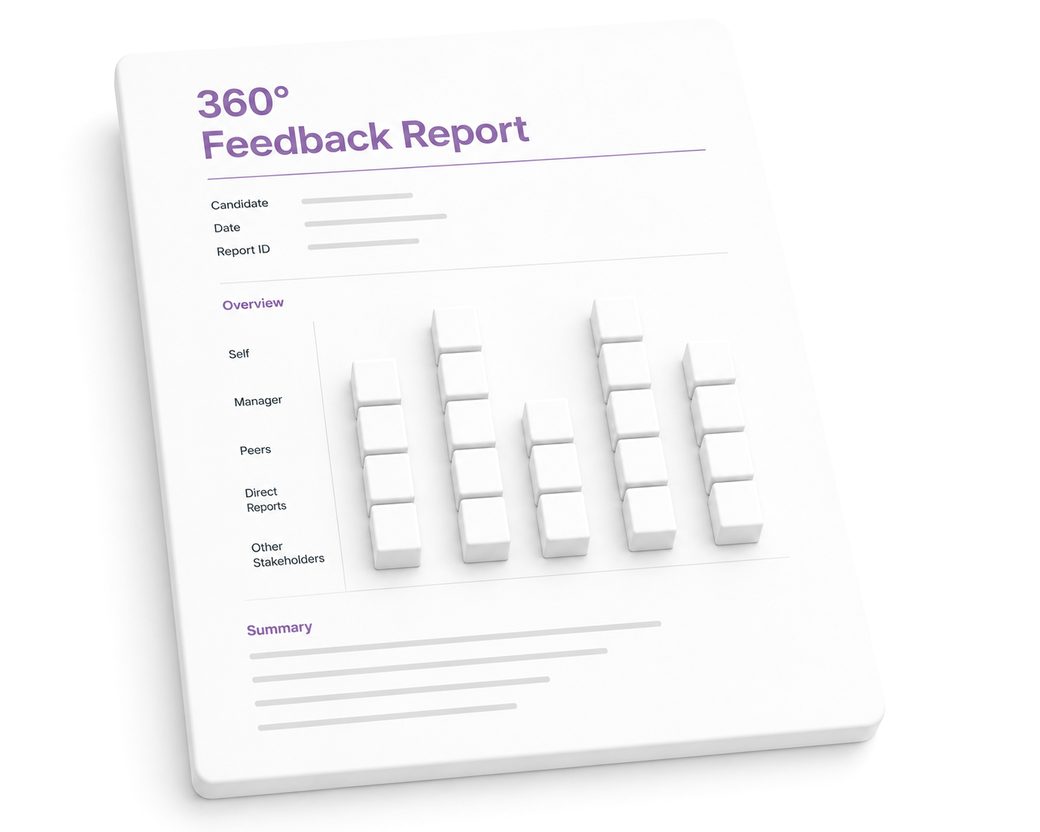
Accessible Feedback Report

A report that presents data clearly, highlights patterns and themes, and provides sufficient qualitative commentary to make quantitative data meaningful.

Individual Feedback

A structured, skilled and empathetic feedback session in which each recipient receives expert support to interpret feedback accurately, identify development priorities and start translating insight into action.

Integration With Development

A clear process for turning 360 Degree insight into specific, realistic and prioritised individual development plans, supported by coaching, manager engagement and development resources where appropriate.

Repeat Feedback / Progress Tracking

A structured approach to repeating the process at appropriate intervals, typically every 12 to 18 months, to track development progress and maintain accountability.

What Organisations Gain

More accurate, complete and multi-source picture of individual leadership and management effectiveness

Improved self-awareness built on evidence and multi-perspective feedback
Targeted plans to address specific behaviours or skills identified as development priorities
Greater individual motivation and commitment to development
Leadership development programmes enhanced by the self-awareness a 360 Degree report provides
More effective coaching engagements based on evidence and multi-perspective insight
Improved talent review and succession planning processes
A stronger culture of honest, developmental feedback
Measurable development progress where repeat feedback processes track improvement over time

Why Organisations Choose White Cube Consulting

Commercially Focused

We understand that 360 Degree feedback represents a significant investment of time and money.

Behavioural and Assessment Expertise

We combine expertise in questionnaire design, behavioural assessment, psychometrics, feedback facilitation and development coaching to design and deliver 360 Degree feedback processes that are rigorous in…

Tailored Design

360 Degree feedback processes designed and built around the specific competencies, leadership expectations, cultural context and developmental purposes of each client organisation.

Facilitation and Follow-Through

The quality of facilitation and follow-through can be as important as questionnaire design.

Trusted Partnership

We build long-term relationships through honest advice, expert facilitation and a commitment to development outcomes that make 360 Degree feedback a worthwhile and lasting investment.


Frequently asked questions

What is 360 Degree feedback and why is it called that?

360 Degree feedback is a structured process in which an individual receives feedback on their behaviour, communication and leadership skills from a range of people who work with them - typically their line manager, direct reports, peers and other key stakeholders. It is called 360 Degree feedback because it captures feedback from all directions around the individual, providing a more complete perspective than any single source can provide.

How many observers should be included?

Four to six observers are typically sufficient - enough to ensure breadth and diversity while remaining practical to administer. Too few observers may produce feedback dominated by one or two perspectives, or where responses are more easily attributable to a specific person.

Is 360 Degree feedback always confidential?

In a well-designed process, feedback is always anonymised and kept confidential, with responses reported in aggregate rather than attributed to specific individuals. The only typical exception is the line manager, whose responses may be separately identified - but only with full disclosure and permission. Clarity about confidentiality is always communicated before the process begins.

Should 360 Degree feedback be used in performance appraisal?

We strongly recommend keeping 360 Degree feedback and performance appraisal as separate processes. When 360 Degree feedback is used, or perceived to be used, as an input to performance ratings or pay decisions, observers tend to become more cautious and the individual more defensive - and the quality of feedback deteriorates significantly.

Give Your Leaders and Managers the Honest Feedback They Need

Whether you are designing a 360 Degree feedback process from scratch, improving an existing process, integrating 360 Degree feedback into a coaching or development programme, or simply ensuring the feedback your leaders receive is honest, specific and well-supported enough to create lasting self-awareness and development commitment. White Cube Consulting can help.